Tuesday, March 15, 2011

Looking back and moving forward. The things I learned while working for Opera.

For the past four and a half years, Opera Software has been at the center of my professional life. It's also been nearly a year since I stopped working for Opera full-time. In April 2010, I shifted from a full-time role at Opera to a part-time role (as an independent contractor/consultant), focusing on Opera's once-a-month State of the Mobile Web report.

Over the last year, I've also been pursuing personal projects, helping my wife launch a successful style blog, celebrating milestones like my daughter's first birthday and my son going to kindergarten, and getting fitter than I've ever been (which will be the topic of my next post).

I've been plenty busy and moving forward. Eventually, my contract work with Opera will come to an end, and I'll be sad to leave, but I'm proud of what I achieved with the company and thankful for the lessons I learned. In this post, I thought I would reflect a bit upon my years at Opera and discuss what I learned.

My first two years at Opera


Some of you already know the story of how I got my job at Opera. Long story short, I was supposed to be working on my doctoral dissertation (on otaku culture in America), but I found myself procrastinating instead, thinking heavily about how certain browsers became popular while others did not (independent of technological superiority on one side or another).

To address such questions, I wrote an article in early 2005--Better branding for Opera—and shared it with the My Opera user community. Shortly thereafter, I was contacted by Opera, and when I completed my degree in late 2006, I started to work for Opera (in San Diego, CA).

I started my professional journey with Opera as a member of the Desktop Marketing team. I joined the company to help Opera understand its users better--especially in the United States--in order to improve how we communicated with them. As part of that task, I had the wonderful privilege of interacting with a lot of Opera users (and non-users) both online and in person. I got to meet people at conferences such as SXSW and numerous Barcamps, helped to create Opera's outreach program (Choose Opera), and wrote articles for My Opera, Opera Watch, Opera Labs, and other Opera-related blogs.

Learning what people cared about regarding the Web and the browsers they used was a lot of fun, and I really loved being a bridge between Opera (the company) and its vibrant user community. Even though I came from an academic background, I learned a lot about internet marketing and online community building. In 2008, however, I moved from Marketing to Consumer Product Management and Developer Relations (later the Products group) at Opera, and it's there that I really stepped up my research efforts.

Product and user research at Opera


As I mentioned above, I didn't have a traditional marketing, business, HCI, or UX background. I was a social scientist, fresh from the world of academia where I used ethnography as the main tool to understand social phenomena (e.g. media fandom's use of technology). As part of the Marketing team, my initial concern at Opera was how to improve communication between the company and the users (and potential users), with the secondary task of compiling and making sense of user feedback.

In 2008 however, user feedback became my primary concern when I moved onto Opera's Product Management team. Suddenly, it became my job to understand how people use and respond to the Opera browser itself (and not just the marketing). Based on my research, I made recommendations to the designers and engineers working on the product.

This was both exciting and scary. I now had some say (albeit small) regarding the direction of a software product used by millions of people all over the world, and I had to make sure that everything I recommended was based on factual evidence and stayed in line with the ideals of the company, not just my own biases regarding what a browser should be.

What I learned


Here are some of the guiding principles I followed and some of the lessons I learned in my role as a user researcher for Opera:

1. For a product with so many diverse users, making the right decision regarding who to study is absolutely critical.

For many years, before I started working for the company, I was a die-hard fan of Opera--interacting regularly with other Opera fans and even Opera employees on the My Opera community. Like my fellow Opera fans, I had no shortage of things that I wished Opera could do, or things that I thought had to be changed. When I started to study Opera's user base (as a researcher), my first instinct was to look at the fan community I belonged to, but I also knew that I had to look much farther beyond that. After all, there is a larger world of Opera users who are not part of (or represented by) the fan community on My Opera, and an even larger population of non-Opera users who are completely different from the core community of Opera fans.

2. Browsers are used in many different ways by all kinds of people.

It's important not to overgeneralize users. When researching users of a multi-faceted product like a web browser, it pays to be particular and precise. Specifics count.

To be most effective, I needed to study users (and their behaviors ) across many different contexts. For example, I had to carefully decide who I would interview among all the different groups of people using the browser, and come up with recommendations that best served as many users and potential users as possible.

Even when conducting survey research, I had to make sure that the results I compiled were organized properly and representative of the groups I was interested in (existing Opera users, new Opera users, users in different countries, non-users, users who were uninstalling the browser, mobile users, etc).

3. It's not a good idea to assume that users, even the technical ones, are very knowledgeable about your product.

It's an understatement to say that Opera is "full-featured" (right out of the box, without having to download any extra extensions, widgets, etc.). For the most part, even "power users" are not completely well-versed in everything Opera can do. A person who knows how to use one advanced feature in Opera might be completely clueless regarding a different feature, even one that is considered "basic" by most people. In other words, almost all Opera users are like novices in one way or another. Even most "browser geeks" (like myself) are normal, everyday users most of the time, so it's not a bad idea to treat everyone as novices regarding most things in the browser.

4. Helping people learn about your product is difficult but worthwhile.

When I first started using Opera, I liked the fact that it held all sorts of secrets for geeks like myself to uncover and share with everyone. Eventually, however, I started to care more about the browser as something that could immediately help more people overall, not just hardcore browser tinkerers.

It's not that I wanted to see the browser simplified to the point that it contained nothing interesting to be discovered. Instead, I thought it was important that we should help all people who use Opera to learn about the things that make it unique. Instead of Opera being a browser strictly for "power users", I've come to believe that Opera should help out anyone who wants to become more effective at browsing the Web. In my mind, Opera should be the program for inquisitive (but not necessarily techie) people who enjoy exploring their technology and what it can do for them, beyond what they're used to.

In that sense, Opera might be considered "the browser that makes you smarter". In my opinion, Opera is the one browser that has the biggest potential to show everyday people (who aren't already browser geeks) all the amazing things you can do with a browser that will help you save time, organize your data, search for information, and communicate with others.

5. Mechanisms to educate people about your product should be subtle, elegant, non-intrusive, relevant, and fun.

There are many ways to help users understand your product, but not all of them are equally effective:

  • You can rely solely on documentation provided to users (e.g. help files and tutorials), but many people don't like looking for or reading directions, and there's an unfortunate temptation to blame users for not reading the manual (or not searching forums and FAQs for previously answered questions).

  • You can have things like the notorious Clippy, but that's the example everyone brings up when discussing intrusive help measures.

  • You can show "tips of the day" within your software, but there's no guarantee that any given tip will be relevant to the user who's reading it at the moment.

On the other hand, many agree that some of the best and most empowering products make sure that:

  • users understand the consequences of their actions (e.g. using clear visual cues to show cause and effect).

  • users are presented with information in a contextual way, such that relevant information unfolds in front of them based upon their actions (as opposed to appearing arbitrarily).

  • users are not afraid of (or otherwise prevented from) exploring the product. Trying out the capabilities of something you own, whether a car or a browser, should be fun and exciting. That's only possible if users can play around with the product without fear of accidentally breaking something that they don't know how to fix.

Parting gifts and fond farewells


Although I haven't been part of the team working on Opera Desktop for over a year now, Opera 11 came out in December (and Opera 11.10 beta debuts at SXSW this week). I've been thrilled to see that some of the research I did made an impact on Opera 11 (and hopefully future versions of the browser).

Specifically, I was involved in conducting research that informed Opera's decision to implement things like:
a) third-party extensions

b) a new way to manage and organize open tabs. (In my opinion, the specific implementation of that--which I had nothing to do with--is brilliant!)

c) visual mouse gestures (see video below). Reflecting upon the principles discussed in point #5 above, I daydreamed the idea and wrote up the initial set of requirements for visual mouse gestures while sitting all alone in Opera's now-closed San Diego office (US operations are now based in San Mateo). As such, I feel a little proud and somewhat nostalgic every time I use that feature.


With a renewed focus on usability and the overall user experience, along with a continued emphasis on pushing the envelope with cutting edge features, I think that Opera is evolving nicely. Before I was an Opera employee, I started as a fan of the browser, and when I finally hand in my keycard, I'll be leaving as an even bigger fan. If all goes well, I'll be using Opera until there's no more Web to browse.

I hope you've found this retrospective interesting, or maybe even useful. When I was in grad school--studying anime fans to earn my degree in Science and Technology Studies--I never imagined I'd have the privilege of working in such an exciting industry.

Post-Opera, I look forward to taking on fresh challenges and exploring new opportunities (either consulting or full-time), so if your company or small business is in need of user research insight, please don't hesitate to contact me. My CV can be found here (and my resume is available upon request): http://www.cjas.org/~leng/cv.htm
 
Finally, I just want to thank all the amazing members of the My Opera community and other Opera fans I've had the chance to meet and interact with over the years. Together, we were always part of something bigger than ourselves, and I hope to see you again soon!

PS: My heart goes out to my friends and colleagues in Japan, and anyone else affected by the tragedy.

Thursday, December 30, 2010

Patton Oswalt on how the Internet is producing weak otaku

On December 27th, Wired posted an article by Patton Oswalt entitled: Wake Up, Geek Culture. Time to Die. I thought it was quite insightful, more than a little provocative, and definitely entertaining. He wrote:

When everyone has easy access to their favorite diversions and every diversion comes with a rabbit hole’s worth of extra features and deleted scenes and hidden hacks to tumble down and never emerge from, then we’re all just adding to an ever-swelling, soon-to-erupt volcano of trivia, re-contextualized and forever rebooted. We’re on the brink of Etewaf: Everything That Ever Was—Available Forever.

I know it sounds great, but there’s a danger:

Read the full article here


Oswalt discussed a lot of topics that I care about, so I decided to share his article on Twitter, Facebook, and now here.

On Facebook, I wrote:

Patton Oswalt's essay on how the internet is making otaku culture weak. It mirrors what me and others (such as Toshio Okada) have been saying - the formation of otaku requires scarcity more than abundance. In my talks and papers, I talk about the otaku's information fetish, where true information = things that are unknown and unavailable. The problem described by Oswalt is what I talk about when I discuss "Otaku issues and challenges". I refer to it as "The Otaku's Dilemma".

This resulted in a nice little comment thread (shared below, with permission):

Mollie Dezern wrote:

I feel like there is a major flaw in this reasoning, and that is that with obsessive interest comes abundance. When I engage in searching for more of that thing, I am diligently hoping to increase exposure. I think what he is expressing is a sense of bitterness that people don't have to work to access the Old thing, and his infatuation with it makes him incapable of seeing that there is a new type of underground that is both away from but facilitated by the internet (for example: doujin collecting). I also don't think he wants to acknowledge that need-love, that is comprised of re-consuming and reconsidering the material, happens even in a supersaturated media environment. Just because there is always something new/now doesn't mean that everyone has transitioned to the new/now. Nerds are archivists, and we function despite the turmoil outside our archive.

In reponse, I said:

Thanks for the thoughtful response, Mollie!

I know there's a lot to disagree with in Oswalt's essay, but I'm not sure it's because his reasoning is flawed. It's not so much that obsessive interest results in abundance, it's just that abundance is simply what we have (now, compared to before; this is a real qualitative difference due to things like the low cost of data storage and transmission).

In terms of what he's longing for, it's a particular feeling. Yes, when we look for something, we hope to find a lot of whatever that thing is, but there's a different feeling associated with looking for and finding that which is uncommon versus that which can be attained with just two or three mouse clicks.

Perhaps he is a little bitter that 'people these days have it too easy', but I don't think it's just jealousy. There's also an understanding that scarcity (even if it's "artifical") has real value in terms of people's happiness and desire for creativity.

I agree with you that there are always going to be niches that are mostly unexplored or have not been co-opted by the internet. That's always been my approach to this problem--always look to the edges of mainstream experience (without falling off the cliff). However, the game has indeed changed. Even doujin collecting (and comic book collecting in general) means something different in this day and age of easily accessible scans (and legitimate digital distribution).

You're totally correct that re-consuming and re-consideration still happens, and I'm sure he knows it still happens, but I think there's truth to the idea that there's less of a need to do so (for many, but not all people). As someone who once watched Tron 8 times in 2 days, I find it hard to imagine doing something like that now (considering how much I own or have access to, including old school stuff, that I haven't had time to read/watch). It's not a purely either/or situation where people consume strictly for depth or strictly for breadth. The Otaku's Dilemma is about otaku optimizing their behavior to maximize their information intake.

Mark Yoshimi wrote:

I think that Oswalt's article reflects the thoughts of a "bitter" geek. Essentially, many of us who could be considered "OG-Geeks", are simply getting older and we've found that many of the things we used to find solace in has now become commercial and mainstream. Our niche in society is no longer a clique. Everywhere you go now you see is Apple logos. Atari, Mario and NES are stamped on t-shirts galore. Now comic book heroes are all over Hollywood (note that they are played by good-looking, non-nerdy actors!). It's now chic to be geek! "Who you gonna call? Geek Squad!" I know when I was little it all started with Star Wars and an Atari 2600. It was only natural for an imagination like mine to move onto the early home computers ala Atari 8-bit. At that time, I was one of the only kids at my elementary school typing my essays. Teachers and other kids thought I was "strange" because I was able to do this and had such interests as hacking and downloading files from BBS's. I was in band and hung out with computer nerds in high school! Who would ever have thought that one of my childhood 8-bit heroes, Steve Jobs, could become one of the prolific icons of the 21st century. One that I now despise as being the root of all corporate evil?

I responded:

Hey Mark,

Thanks for your thoughts.

I still think it's possible to be an "OG-geek", as you call it, without feeling bitter or indulging in nostalgia for its own sake. I've decided a long time ago (with Carol's help) not to look down on mainstream/commercial things. I've met people who think I'm unable or unwilling to enjoy popular entertainment--and they're sometimes disappointed when they see how common my tastes actually are ;)

Of course, I still love niche subjects, and when they're co-opted (as so many good things are), the best recourse (IMO) is to move onto new things and/or use our knowledge (of previously-fringe subjects) that is now in high demand. So, maybe we can feel bittersweet instead of bitter, and hopeful (though possibly adrift) as we look for new challenges, unconventional diversions, and uncommon artifacts...until they invent replicators. ;)

PS: Hooray for BBSes!

Friday, December 17, 2010

My thoughts on Tron, Tron: Legacy, and what it all means to me

(Note: the following article is pretty much spoiler-free regarding the plot of both Tron and Tron: Legacy; it's also really long...)

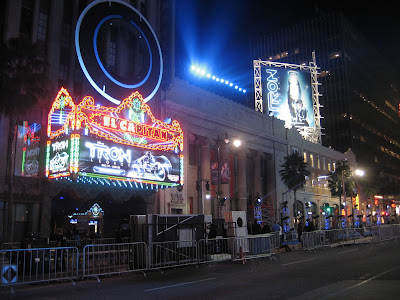
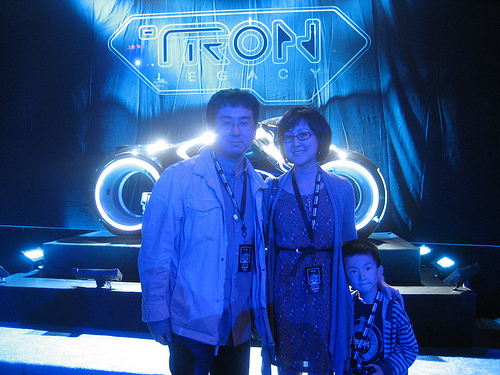
Today is Tron: Legacy day. By now, a lot of people have seen the movie or are about to. Personally, I was very lucky to have seen it last weekend--at the Hollywood premiere--courtesy of a contest I won sponsored by ESET (makers of the antivirus software I use).

Tron Legacy Hollywood premiere

Even had I not gone to the premiere (and after-party), which was awesome (see my wife's blog post about the event and my photos here: Tron: Legacy Hollywood premiere), I surely would have gone to see Tron: Legacy as soon as humanly possible. It's a movie I waited for with eager anticipation ever since I heard about it at Comic-Con in 2008, and something I've been thinking about for decades, ever since I watched and fell in love with the original back in the 80s.

After watching Tron: Legacy, I was left with very mixed emotions, which I'll explain in more detail below. Even as I write this, I'm ambivalent, and I have a feeling that future viewings of the movie will continue to affect my opinions of it. Since Saturday, I haven't been able to stop thinking about Tron: Legacy and now I'd like to share my thoughts on it.

Tron's enduring role in my life


You see, Tron: Legacy isn't just this year's holiday blockbuster to me. That's because Tron (1982) isn't just a movie that briefly entertained me as a kid. Tron has been, and still is, one of my favorite movies of all time (easily in my top 10). I didn't see it in the theater, but I watched it on television around 1984 or so, an experience I remember vividly (I was 8 years old). My friends and I discussed light cycles at school, and we thought Tron: Deadly Discs on Intellivision (YouTube link) was the coolest game ever. My parents never let me buy a lot of toys, so I remember being very envious of my friends who had Tron action figures and light cycles. It wasn't just the effects that I liked; every aspect of the story appealed to me, and every scene sucked me in (even the ones a lot of people consider boring). As an idealistic kid, I was able to enjoy Tron as a fantasy/allegory, as opposed to a sci-fi film that requires a strong real-world premise (which you won't find in Tron if you mistakenly look for it).

When I discovered that my local public library had the VHS tape of Tron, I promptly checked it out. Over the two days I had the movie at home, I watched it a total of 8 times. To this day, I've never rewatched anything that many times in such a short time span.

During my first few weeks of college, I discovered and fully jumped into online fandom for the first time--interacting with fellow science fiction, fantasy, and anime fans. In one of my earliest Usenet posts ever (dated September 9th, 1994, on alt.cult-movies), I wrote about Tron:

I love this movie! I have the novelization and I like the
Peoplemover ride at Disneyland only because it has a TRON sequence in it.
Anyhow, I don't know anyone (other than myself) who liked the movie that
much. Any idea where I can find a soundtrack for it?
Lawrence

This was before the soundtrack was available on CD. Someone responded to my query and actually mailed me the actual soundtrack (on cassette) for free!

Tron novelization

(I read this so much, it fell apart)

Laserdisc collectors will fondly remember Ken Crane's LaserDisc SuperStore. It wasn't that far from where I lived, so one summer I went there and rented the Tron laserdisc (from Disney's Exclusive Archive Collection). Before the 20th anniversary edition of the Tron DVD came out, the laserdisc set (which I now own) was the only way one could watch the special features explaining how Tron was made. After watching those special features, my appreciation of Tron went through the roof.

Tron laserdisc - frontTron laserdisc - back

(Tron on laserdisc)

As a child of the 80s, I was primed to be influenced by Tron, and influence me it did. I'm not sure it's accurate to say that I got into computers and information technology because of Tron, but it certainly colored my technological worldview. Upon learning how Tron was made, I was inspired by the artists who created it and the scope of their accomplishment as storytellers and filmmakers. Sure, Tron didn't do well at the box office, but it also had to compete with E.T., which I did see in the theater and didn't like. (Ironically, Tron spawned successful video games, whereas the much-hated E.T. game is considered partly responsible for crippling the video game industry for years.)

Tron - an experimental art film disguised as a Disney children's movie


As far as I'm concerned, Tron was an incredible product of the 80s, not just far ahead of its time, but completely unique in its execution. That's why I was always skeptical and not very enthusiastic whenever someone spoke about a Tron sequel. What Tron accomplished could never be done again, I thought. After all, Tron was amazing, not in spite of the technological hurdles it had to overcome to tell its story, but because of those hurdles.

In creating Tron, a whole slew of tools and techniques had to be invented to tell the story the way they wanted it. Arguably, using today's technology, it ought to be fairly easy to recreate the look and feel of Tron, but to what end? To make the original Tron, Lisberger et al. used every last bit of technological know-how they could muster, and they strained their imagination to the breaking point to envision a completely artificial, but stunningly beautiful, world of programs that lived and breathed inside our computers.

In one of the laserdisc special features, one of the Tron staff said something to the effect of 'Art is defined by its limitations. The essence of a painting is its frame.' The greatest art is not what you can do with the largest canvas, the fanciest tools, or the biggest palette of colors; it's what you're able to accomplish with the what you have, accepting limitation as the mother of inspiration and true creativity. It's the reason why radio is not necessarily better than books, why television is not necessarily better than radio, why color is not necessarily better than black and white, and why photorealism is not necessarily better than illustration. The examples go on and on. Art needs to be judged in context; in context, what Tron achieved (artistically) was nothing short of amazing.

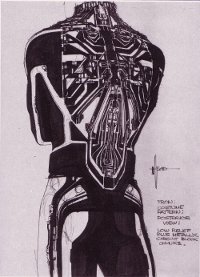
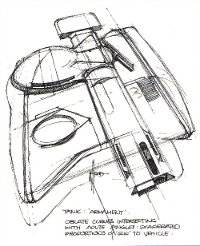
People routinely mention how Tron was so revolutionary in terms of its computer graphics (which it was), but they often forget that the overall look was achieved via a blend of CGI, traditional animation, live-action (70mm, black and white!), and one-of-a-kind lighting effects. Like its soundtrack by Wendy Carlos, combining synthesizer and live orchestra music, Tron is a triumph of both digital and analog technologies, meshed with the artistic and design sensibilities of Syd Mead and Jean Giraud (Moebius), visionaries of the highest order.
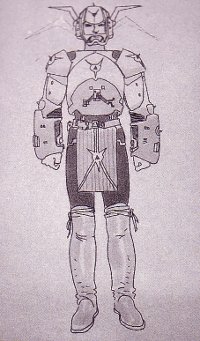
Moebius Tron designSyd Mead Tron designSyd Mead Tron design

(Tron designs by Syd Mead and Moebius)

So what does this all mean for Tron: Legacy? For me, at least, it meant that Tron: Legacy had a lot to live up to, and doing so was probably not going to be easy. Most of all, I was afraid that a sequel, if ill-conceived and/or poorly executed, would tarnish the legacy of the original. (That's based on my personal conception of the original, of course. I fully realize that most people don't view Tron the same way I do).

Prepping Tron for a new generation


As we got closer to the release of Tron: Legacy, more and more details regarding the film were revealed, preview clips were screened online and in theaters, and a ton of merchandise hit store shelves. The Disney marketing machine has been going all out, and I happily bought into the hype and anticipation. After all, if the images and video clips were any indication, the movie was clearly going to look and sound great. The basic story, as revealed in staff interviews and various story books, seemed like it would be entertaining, and the movie's stars and creators said all the right things when interviewed. It promised to draw in and impress new viewers while giving something back to the old-school fans like myself.

Now, I know that different people look for and appreciate different things in the movies they watch, and people with different personalities and expectations will react very differently to the same film. I find very little value in worrying about how other people judge the art I like, and I similarly don't claim any privileged perspective regarding such art. It's just how I feel, based on my own particular background and personality. I'm not a movie critic, and I don't want to be. What follows is strictly my opinion, and I encourage you to watch the movie for yourself because a) you might like it, b) you might find it interesting, and c) you'll likely be impressed by the spectacle of it on a big screen with theater-grade audio.

My general impression of the movie


All of that said, I was mildly satisfied with Tron: Legacy, which of course means that I wasn't satisfied nearly enough. I guessed that it wouldn't break into my top 10 movies, but I at least hoped it would become one of my favorite movies (which it sadly isn't). I'll still watch it again (in IMAX, since the El Capitan Theatre showed it in Real D), and I will definitely buy it on Blu-Ray, but it's not destined to affect me the same way the original one did, and I doubt it will affect my 5-year-old son in the long run either (though he might prove me wrong, and he definitely had fun watching it!). It was entertaining enough (despite its flaws), just not as groundbreaking or well-told as I wanted it to be.

I also find myself unable to predict how the general movie-going public is going to react to the film. It seems that professional reviewers (about half of them, so far) have been pretty harsh in their assessment. Normally, for certain kinds of movies (like Tron), I don't care about the opinions of mainstream reviewers. This time, however, I found myself agreeing with many of their main criticisms--that the movie looked and sounded great, but had a poor screenplay and suffered from lackluster directing in scenes that should have had dramatic weight, resulting in a treat for the eyes and ears but was not particularly soul-stirring.

To be honest, I've been surprised at how much goodwill the unreleased movie has been getting from a crowd that probably never even watched the original. Daft Punk-hysteria aside, my only explanation is that Tron: Legacy's futuristic aesthetic is appealing to a new generation that's really into technology. Perhaps the look and feel of Tron: Legacy is an affirmation of our gadget lust, serving as proof that we're demonstrating good taste (and good sense) when we buy products because they look nice and have sexy user interfaces. Anticipating Tron: Legacy, like browsing the Web at work, allowed us to escape into a virtual world where everything is cool, entertaining, and the problems we encounter can be solved by the application of more technology. (The actual movie tried to be a bit more complex than that, and some reviewers are already complaining about its pessimistic tone.)

Undeveloped potential


In any case, I was looking for more than aesthetic escapism, and I actually thought the film's concept was generally sound. They tried to tell a compelling story, and everything was in place for them to make a challenging, unconventional film that would inspire cult fandom as well as entertaining the masses. The themes they tackled sounded great on paper--father-son relationships, the perils of playing God, technology out of control, the roots of fascism, the importance of embracing uncertainty, etc. Unfortunately, the overall execution was lacking.

In terms of the storytelling, I feel as if the writers unintentionally made the film worse by including too many things that harkened back to the original Tron. In spending so much time making sure the continuity fit between the old and the new, less time was spent on characterization and meaningful drama. Also, making sure that the new movie had lines of dialogue (and whole scenes) that referenced the original meant fewer scenes that were truly innovative. I'm usually a fan of postmodern pastiche and homage, but all the little "easter eggs" referring to the original movie got boring after awhile. They felt like a cheap way to score some points with the core fans, but I felt pandered to instead of challenged. It's possible that the writers threw in a WarGames reference. If that's true, it's the one bit of homage that I really enjoyed because it was a true inside joke, instead of just being a recycled line from within the same franchise (I'm reminded, sadly, of the Star Wars prequels). I'm no expert on writing movies, but there must be better ways of pleasing old-school fans than simply repeating old material in a slightly different context.

Talkin' 'bout my generation (of storytellers)


I wonder if the age of the director (Joseph Kosinski, b. 1974) and the writers (Edward Kitsis, b. 1971 and Adam Horowitz, b. 1971) had anything to do with it. Those guys are part of my generation, kind of in the vague middle ground between Gen X and Gen Y, born sometime between 1970 and 1982 (for the sake of argument). I'm not really convinced that my generation has produced any great long-form storytellers. We seem to be good at producing commercials, trailers, music videos, YouTube clips, or maybe even TV episodes, but not necessarily feature films or novels. In learning how to please people with short attention spans and a need for instant gratification, are we losing our ability to tell longer and more complex stories that require patience to tell (and enjoy)?

It's not as if my generation is too young. Steven Lisberger, the creator of Tron (1982), was only 31 when it came out, George Lucas was 33 when Star Wars (1977) came out, James Cameron was 30 when Terminator (1984) came out, J.K Rowling published Harry Potter (1997) when she was 32, and John Lasseter was 38 when Toy Story (1995) came out. Of my generation, Christopher Nolan (b. 1970) and Stephenie Meyer (1973) are the only two really successful creators of long-form fiction I can think of, and I list them because of their popularity, not because I particularly like their works. But other than those two, who else is in the running to be the greatest storyteller born between 1970 and 1982?

Reasons to like Tron: Legacy


Story aside, there's no denying the visual splendor of the new film, and I really dig the updated designs, especially the vehicles. I don't at all regret buying the $40 Tron: Legacy art book and numerous toys for my son. As a veteran Armagetron addict, I love Kevin Flynn's retro light cycle they designed for the new movie. Unlike the original film, I don't know if any of the special effects in Tron: Legacy will be considered groundbreaking (there's been mixed reaction regarding the 'young Jeff Bridges' effect), but at least it's all nice to look at.

Kevin Flynn's retro light cycle

(Flynn's light cycle, source: /Film)

In the Tron DVD special features, John Lasseter remarked that Pixar would not exist if not for Tron. Will we be able to say something similar about Tron: Legacy? It's hard to imagine, but who knows. In my opinion, the original Tron was greater than the sum of its parts, whereas Tron: Legacy isn't, but those individual parts (such as the epic soundtrack by Daft Punk) are praiseworthy nonetheless.

"Like the man says, there's no problems, only solutions."


Tron: Legacy may be flawed, but it's still something I'm glad that I experienced, and I'm not averse to new (and better) stories being told in the universe it portrayed. Indeed, it seems like Disney is getting ready to tell those stories (via a Tron cartoon, for example) if there's a receptive audience. I hope they take their time and plan carefully if they decide to make Tron 3, however.

I was worried that Tron: Legacy would diminish how I feel about Tron, but that proved not to be the case. Some reviewers who are disappointed with the new film have been eager to point out their dislike of the original, as if that explains the new film's failings. For me, the new Tron (which was disappointing but far from awful) actually makes me appreciate the old one even more, which is a happy ending in my book.


Update (12/31/10):

So, I finally had a chance to rewatch Tron: Legacy, and I have to say that I enjoyed it more the second time around (as expected). Instead of being constantly dismayed at what the movie could have been, I was able to spend more time appreciating it for what it was--looking for its strengths instead of its weaknesses.

There were still moments where I found myself shaking my head in disappointment or disbelief, but overall I was happier. In fact, I want to give Joseph Kosinski a little more credit that I did before, as I noticed a few neat storytelling tricks that I missed the first time.

And sure, I wanted Tron: Legacy to be more inspiring artistically, but I can forgive it for not surpassing the original film in that department. Perhaps the techie side of Tron: Legacy was oversold (the marketing certainly didn't focus on the storytelling), or maybe it's just going to be much harder to inspire the next generation of creative folk.

After all, it takes a lot more to dazzle us now, and the filmmakers were saddled with having to emphasize the past instead of pushing more toward the future. Or maybe I have it all wrong; maybe the special features on the Tron: Legacy Blu-Ray disc will blow me away (like I was blown away by the special features on the Tron laserdisc).

Unfortunately, I'm still less forgiving of Tron: Legacy's storytelling (e.g. its screenplay). I don't mean the story (plot, concepts, etc.), but the way it was told (pacing, structure, perspective, dialogue, and editing). All judgments of artistic achievement aside, I just wanted a well-told story. I actually look forward to seeing if the novelization and/or comic book adaptation does a better job.

As a final note, I do recommend seeing Tron: Legacy in an IMAX theater. Maybe it's just my imagination, but the IMAX picture and sound at my local theater seemed to be better than the picture and sound at the Hollywood premiere (which featured Disney Digital 3D).

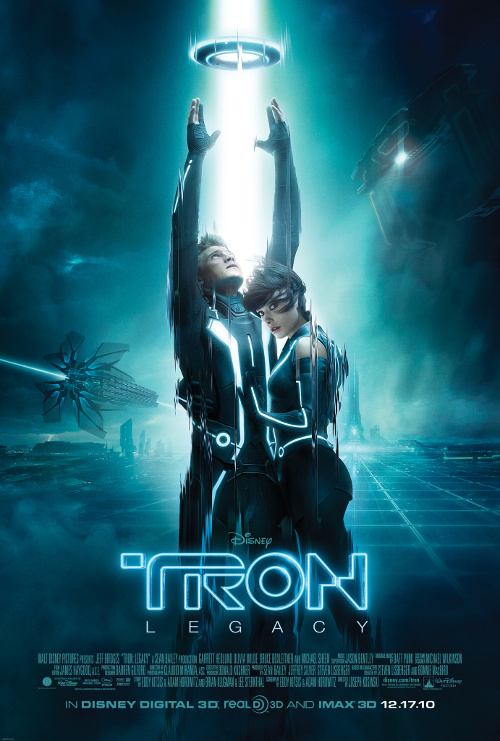
Tron: Legacy poster

Saturday, December 11, 2010

Live and direct from the Tron: Legacy Hollywood premiere

Hi everyone, I'll share the full story and more detailed thoughts later, but long story short...I'm attending the Tron: Legacy Hollywood premiere!

I have to thank the awesome folks at ESET for this amazing opportunity. A week ago, I entered an online drawing (sponsored by ESET) for a chance to see Tron: Legacy's big premiere in Hollywood, at the El Capitan Theatre. The premiere is today, nearly a full week before the general release of the movie, and it looks like Disney pulled out all the stops to make this event amazing.

I'll definitely post a full report after the event, but if you want to see live updates, follow me on Twitter (where I'll likely be using Twitpic) and/or check out my Flickr gallery for photos.

@Lawmune on Twitter

Tron: Legacy Hollywood premiere
(pictures from the event on Flickr)

Tron: Legacy Hollywood premiere


My wife Carol might also be tweeting about the event. Follow her here:

@raphaela235 on Twitter


Here is Carol's blog post containing her impressions and photos from the premiere and after-party: What I Wore (Tron: Legacy Hollywood Premiere)

Here's her first post about the event: Blue Carpet Outfit

A little while back, she blogged about our visit to the Tron Pop-Up Shop in Culver City.

Enjoy, and stay tuned!