Thursday, March 30, 2006
My Thoughts on Anime : An Interview
In 2004, I was contacted by a high school student who was doing a research project on anime. As part of that project, she had to interview someone who was formally studying anime (and/or related topics). She found me through the Anime and Manga Research Circle and interviewed me over email. The questions were fairly general but fun to answer, and the interview allowed me to express thoughts concretely that were previously just floating around in my head.
Here is the interview (republished with permission):
1) What do you like about anime and manga?
I like many different things. First off, I like the stories and the art. I think animation allows one to do things in terms of exposition and special effects that you can't easily do in live action films. In my opinion, Japanese animation is currently doing a better job (than American animation) at expressing the full potential of animated stories.
There are so many anime production companies in Japan, and manga is well-respected as reading material (whereas Americans tend to view comics as being kids stuff). Because of these factors, perhaps, there is a wide variety of anime and manga available, targeted towards specific age groups, genders, etc. There's something for everyone, in other words.
I also like the fact that I can enjoy something produced by people from another culture. By watching anime and reading manga, I can learn about that other culture, or at least get a sense of their perspective on the world.
As an American fan, it's especially interesting that I'm not part of the target audience. These Japanese shows were not meant for me. Nonetheless, I can engage them on my own terms, and I can freely watch whatever genre I want. In Japan, if I was 27 years old, watching a show intended for 13 year old girls, people I know might look at me funny. But since I'm in America, watching something not meant for me in the first place, watching that show isn't as weird for some reason. I'm being entertained, but I'm also learning about a foreign culture, and if I don't care that I'm not part of one target audience, why should I care that I'm not part of another? There's a certain sense of freedom and self-determination I get when watching something that was not specifically marketed to me (and members of my demographic).
2) What got you interested in researching about it?
I've always been interested in extreme fandom, the way that people get involved with media products in ways that some people call "obsessive" and "unhealthy", in ways that the producers of those products never intended or would never hope for. I want to know what it is these extreme fans are doing, and why they do it. Where do they come from, and what do they get out of it? How do they deal with negative stereotypes that are used to characterize them? Japan has the perfect word for these kinds of fans: otaku. The focus of my research is on otaku. One can be an otaku of just about anything, not just anime or manga, but for some reason, anime and manga tends to attract otaku, maybe because the anime creators themselves are otaku and know what it is that otaku enjoy in their anime.
Since anime is my own domain of expertise, and I have participated heavily in American anime fandom, I am researching anime otaku in particular. I am specifically interested in how otaku use scientific methods and technology in interesting and unexpected ways.
This all fits into my broader interest regarding youth subcultures in general. Here are some questions I am trying to address: How are youth subcultures important, and maybe even useful, in mediating adolescent identity? Is it possible to have a "middle-class subculture", and if so, what does that imply? What conditions make "middle-class subcultures" necessary? How can subcultures provide an alternative to self-destructive youth violence?
3) How do you think the Japanese culture influence the America society?
Various aspects of Japanese popular culture are really making strong inroads into American popular culture. Some things, like Pokemon, have actually become mainstream, but I would say that most anime-related things have not yet achieved that status (and most probably never will). Anime is getting more and more popular, to be sure. How popular will anime get amongst the mainstream American population? Only time will tell.
In terms of anime relaying Japanese cultural norms that might be affecting American cultural norms, that is a much harder question. First, it's important to understand that American culture influences Japanese culture as well; for example, many anime creators have expressed their love of American movies. In this age of globalization, it's hard to say what is specifically Japanese culture versus American culture. I think I will leave this question for others to answer. [One aspect of this issue that strikes me as interesting, however, is the question of Japanese sexual norms (as portrayed in certain anime) potentially coming in conflict with American sexual norms.]
4) What are your ideas about cosplay?
I think cosplay is very interesting. I have friends who have done cosplay at major conventions, but I've never done it myself. I'd like to find out what motivates cosplayers.
5) Have you ever attended any anime festivals? If so, what was it like?
Yes, I've been to many anime conventions. I enjoy them very much. It's where otaku (and more casual fans) have a chance to truly be themselves and have fun amongst others who understand them. Cons are a great social experience, and I always look forward to them. Anime _can_ be enjoyed as a solitary pursuit, but sharing it with others has always been strongly appealing to me.

Monday, March 27, 2006
Counteracting Sameness on the Internet
The internet is considered a place where everyday people can creatively express themselves. That is certainly true, but you also see a lot of outright copying (and illicit republishing) of online material. Of course, the popular stuff gets copied the most, and is also the original source material for most of the derivative works, criticism, and analysis as well. In Science Studies, it's what we call the Matthew Effect (described by Robert Merton in 1968), which is essentially a restatement of the fact that the rich get richer and the poor get poorer. It's why, for example, certain blogs have thousands of inbound links, while the majority of blogs have none or just a handful. (Economists use the term "power law distribution" to describe this type of phenomenon. In describing the Matthew Effect, Merton gets into the psychosocial causes of this particular behavior and its implications.)
Because of the way Google works (ranking pages according to popularity), popular content on the Web is what gets noticed and becomes more popular over time while less popular content gets buried deeper and deeper over time, making it especially hard for new content and websites to get on an equal footing with old websites with pre-established audiences (and therefore good PageRank).
The content of popular sites is what tends to get replicated on other sites as well. With open sources of information like Wikipedia (published under the GNU Free Documentation License) becoming more and more popular with internet users, that content is also being heavily replicated (word-for-word in many cases) on other websites (including other popular online encyclopedias). As a result, alternative and less popular sources of knowledge become harder to find amidst the sea of copied information.
The ability to copy information without directly altering the original might avoid the 'tragedy of the commons', but it can result in a tragedy of another sort, a Tragedy of Sameness, a type of information entropy where all knowledge moves towards an equilibrium where everyone knows the same things about the same topics, and nothing really new is said or created.
Web content that can be copied and republished freely often becomes more popular than similar content that is more strictly controlled by their original authors, especially when the free content has been around longer. The tragedy occurs when this free (as in beer and as in speech) content is of lower quality than the non-free content, and the non-free high quality content can't compete in the long run and therefore disappears forever (to the detriment of everyone).
The precariousness of being in The Long Tail
It is said that The Long Tail is good for content that is not in high demand, that sites such as ebay, Amazon, and Netflix make it possible for niche content to survive and get exposure they wouldn't get otherwise (while making those companies a lot of money). Such sites and Long Tail content are mutually beneficial to each other.
Wikipedia also benefits from having a lot of niche content that could be considered in the Long Tail. There are many specialized articles that don't get read a lot, but the fact that they exist adds tremendous value to Wikipedia. (Print encyclopedias, on the other hand, are much more constrainted regarding the types of articles that get printed.) I'm not convinced, however, that Wikipedia is reciprocally beneficial to independent website creators, many of whom initially research and publish the valuable information that Wikipedia later incorporates. As Wikipedia and other megasites get popular, the independent websites are increasingly being pushed into the Long Tail of the Web and face the very real threats of obscurity and/or extinction.
The growing usage of megasites to get information on niche subjects can, in many cases, reduce the demand for independently created sites that cover the same content. With reduced demand, there becomes less incentive (monetary or otherwise) to produce such content independently, and the Web becomes populated by clones of Wikipedia articles and the other most popular sites on Google for any given subject. What used to be a collection of incredibly diverse (and sometimes quite expert) opinions and analysis on a multitude of subjects is increasingly becoming a boring monolith of sameness.
Even the new material posted on the internet these days that is considered "fresh and exciting content" is mostly superficial and ephemeral in its appeal, intended for audiences with brief attention spans. Scouring the Web for fascinating, well-researched, and wonderfully trivial details about arcane subjects has been replaced by surfing the Web for funny little photos and video clips, people's daily diaries, fanlistings, virtual slambooks, quickly accessible facts from reference pages, and easily digestible news articles (about current events, celebrity gossip, the latest tech gadgets, etc.) I browse and am entertained by those things too, I admit, but I'm also worried that "heavy" content on the Web is getting more and more scarce.
My Modest Attempts at Cultural Environmentalism
I try, even though it's hard, to avoid replicating the content (e.g. stuff on Slashdot or Digg) I read every day on the internet, a lot of which is actually fun stuff that lainspotting readers might be interested in. When I get the urge, however, I just remind myself that a ton of people are already linking to those things, and I don't need to add noise to the system.
I also try (with varying amount of success) to avoid linking to Wikipedia articles. Wikipedia is a great resource to quickly learn about new stuff, but I much prefer to support those independent website operators whose hard work results in truly original and in-depth content (that benefits from the accountability of having the author's name attached to it). Much of that content ends up being the (often uncredited) source material for Wikipedia and other megasites anyway, but in the process of being transferred, details get lost or are presented out of context.
Furthermore, Wikipedia contributors and editors tend to err on the side of caution (or stinginess, depending on your point of view) regarding external links (whether it was the source of the info, or alternative information) for fear of link-spamming. Yet, robust linking is what made the web great to begin with. It's becoming a lost tradition. Few people, even small website owners, want to link to potential competitors for fear of losing ad revenue in the long run. That search engine optimizers have to debate whether or not outbound links will negatively affect their PageRank is another tragedy, and the quality of the Web is suffering because of it.
Google and Originality
Ironically, I started this post with the intention of writing just one or two lines on how Google can be used to aid creativity. I just wanted to note that Google is a great tool for checking to see if a phrase you came up with has been coined or used before by anyone else. In something I wrote a few weeks back, I used the phrase "toothless ambition" and wondered if anyone had used it before me. Google says no, so I'll claim it as my own. =)
Related links
Browsers and the quality of web content [edit: added 3/28/06]
What happened to anime "shrines" on the web?
Friday, March 24, 2006
Murakami does the NYU Course Catalog
Do course catalogs get any cooler? Pop/otaku artist Takashi Murakami designed the cover of this recent NYU catalog:
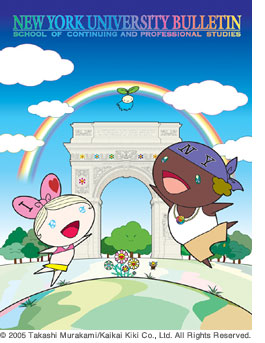
More info: NYU -SCPS's ANIMEted Summer
Pre-web anime fandom (Out of the Archives 4)
In the late 80's and early 90's, the internet was not yet widely available to the American public. Anime fans were already online, however, communicating with each other and sharing resources on services such as Prodigy, CompuServe, AOL, and GEnie. On a more local level, anime content could also be found on some BBSes, and there were even some anime-specific BBSes. Those who had access to the internet also shared material via Usenet, FTP, and Gopher. A lot of these became much less important after the World Wide Web took off in the mid-90's, but looking back, we can appreciate how they paved the way for today's vast information culture surrounding anime.
Here is a print ad from 1991 for the anime discussion boards found on GEnie.

Students of CJAS history should take note that one of the two sysops for the anime board was Richard Copeland, who (according to the ad) regularly attended CJAS (then known as CJS, the Cornell Japanimation Society). Lea Hernandez, the other sysop, was the vice president of General Products USA (the American merchandising division of Gainax) from 1989-1990.
One way that old school anime fans shared information with each other was through text files that were distributed across various bulletin boards. Anime Stuff, first published by Tom Mitchell in January of 1987, was one of the most well-known newsletters. Tom was a sysop of "The CompuServe Anime & Manga Forum". Starting with issue #5 (11/12/1987), none other than CJAS co-founder and first president Masaki Takai joined Tom in producing the newsletter. Masaki, then a freshman at Cornell, hadn't even started CJAS yet (the club was "born" on September 9th, 1988).
Issues (with associated images) of Anime Stuff are still available for download at the SUNET FTP archive's mirror of the much-loved but now-defunct Venice anime and manga FTP archive: Index of /pub/comics/anime-manga/anime.stuff
An even more accessible collection of Anime Stuff can be found here: Index of /OSA/PUBLICATIONS/anime-stuff courtesy of J!-ENT's Old School Anime website, which is a pretty fun read if you were a fan from that time, or if you're interested in that particular era of fandom.
Years before the CJAS newsletter was started in 1992, Masaki was already contributing heavily to Anime Stuff. Search the following index to find the articles he submitted: asindex6.pdf
Some readers might be interested in the interviews with Roe Adams and Masaki, in issues 17 and 20 respectively, where they talk about the early days of CJAS and the founding of Animeigo.
Related articles
Otaku no CJAS: Graffiti of the Otaku Generation 1988
10 Years of Decadence, CJAS-Style (another CJAS history article)

One way that old school anime fans shared information with each other was through text files that were distributed across various bulletin boards. Anime Stuff, first published by Tom Mitchell in January of 1987, was one of the most well-known newsletters. Tom was a sysop of "The CompuServe Anime & Manga Forum". Starting with issue #5 (11/12/1987), none other than CJAS co-founder and first president Masaki Takai joined Tom in producing the newsletter. Masaki, then a freshman at Cornell, hadn't even started CJAS yet (the club was "born" on September 9th, 1988).
Issues (with associated images) of Anime Stuff are still available for download at the SUNET FTP archive's mirror of the much-loved but now-defunct Venice anime and manga FTP archive: Index of /pub/comics/anime-manga/anime.stuff
An even more accessible collection of Anime Stuff can be found here: Index of /OSA/PUBLICATIONS/anime-stuff courtesy of J!-ENT's Old School Anime website, which is a pretty fun read if you were a fan from that time, or if you're interested in that particular era of fandom.
Years before the CJAS newsletter was started in 1992, Masaki was already contributing heavily to Anime Stuff. Search the following index to find the articles he submitted: asindex6.pdf
Some readers might be interested in the interviews with Roe Adams and Masaki, in issues 17 and 20 respectively, where they talk about the early days of CJAS and the founding of Animeigo.
Related articles
Otaku no CJAS: Graffiti of the Otaku Generation 1988
10 Years of Decadence, CJAS-Style (another CJAS history article)
Subscribe to:
Posts (Atom)